.png?width=1452&height=474&name=Greenspace%20Logo%20copy%20(1).png)
Apparently, there are 24 varieties of Sumac. Our Kentucky native sumacs are Winged Sumac (Rhus copallinum), Smooth Sumac (Rhus glabra), Staghorn Sumac (Rhus hirta), and Fragrant Sumac (Rhus aromatica).
As named, the Winged Sumac has wings along the leaf stem; the Smooth has no wings. The Fragrant Sumac is the only one that has a strong, sweet, citrusy aroma when leaves or stems are crushed. Staghorns are much taller and more aggressive, and the velvety, hairy branches resemble the antlers of a young stag, hence its name.
All have fuzzy red fruit clusters, called drupes, which are small berries. These drupes are edible with a tart, citrusy flavor like lemon or tart cherry. This is not the same as the common culinary spice. The culinary sumac is from the deep red, thin-fleshed drupes of Rhus coriaria, a Mediterranean species in the cashew family (Anacardiaceae). You can also make dye and ink from the deep red drupes.
Not to be mistaken for the toxic Poison Sumac (Toxicodendron vernix)!
Poison Sumac has smooth stems, grayish-white berries, and typically grows in very wet swampy areas.
SMOOTH SUMAC
We have Smooth Sumac in our greenspace, which has the following characteristics:
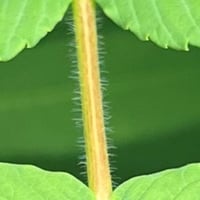 Stem: fuzzy branches
Leaf shape: Broad, pinnately compound (growing opposite each other, like feathers) leaves with smooth, rounded leaflets (no wings).
Growth habit: Low, spreading shrub (6 ft), often forming dense thickets.
Foliage color: Green in summer, bright red to orange in fall.
Flowers: Small white to yellow flowers in late spring.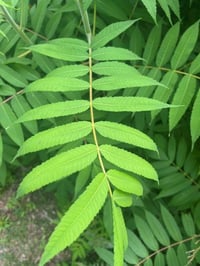
Fruit: Small, red, fuzzy drupes in summer/fall.
Scent: No strong fragrance.
Habitat: Full sun to partial shade; drought-tolerant; common in open fields and woodland edges. Native sumac spreads rapidly through an extensive network of underground rhizomes
The greenspace has few areas of sumac, including a nice thicket of sumac under the electrical transmission line (tall, high-powered lines) close to the Jacana entrance. It was clear cut by Kentucky Utilities in October 2025, which spurred a big growth from the sprawling roots. Although it is a native with many fine qualities, it can spread rapidly. Our goal is to have diversity. So, managing this native sumac requires a balance between utilizing their ecological benefits and preventing them from becoming aggressively colonizing thickets. The most effective strategy combines mechanical cutting and root-sprout control. We do not want to use herbicides unless there’s no other way.
Questions to Answer
Do we keep the sumac under the transmission line? Since KU apparently cuts sumac from under the transmission line, should we even keep it there?
Do we remove the sumac under the transmission line and replace it with low growing shrubs, herbaceous plants, and/or pollinators, meadows and cut flowers? Then, focus on other areas of existing sumac groves
Sumac Management Plan
Goal
To retain a healthy patch of native smooth sumac in the greenspace while preventing it from expanding into a large, single-species thicket. The preferred approach is non-chemical control, using repeated cutting, root-boundary maintenance, and routine monitoring.
Desired outcome
Preserve ecological value while improving plant diversity in the greenspace.
Primary strategy
Maintain an existing colony but contain it in a defined area. To keep our native sumac contained to a specific size without killing the main colony, we must focus on stopping its underground runners.
Establish a Hard Border
Option 1: Install a Root Barrier: This is the most permanent solution. Bury a 60-mil HDPE (High-Density Polyethylene) bamboo barrier 12 to 18 inches deep around your designated sumac zone. Leave 2 inches visible above ground to catch rogue surface roots.
Option 2: Spade Edging: Once every spring and fall, drive a sharp, heavy-duty spade straight into the ground along your desired boundary line. This cleanly severs the horizontal underground rhizomes connecting the main colony to any outward-creeping runners.
Create a Mowed Buffer Zone: Maintain a 10-foot-wide strip of lawn entirely around the sumac patch. Mow this zone weekly during the spring and summer. Frequent mowing easily starves and destroys any new suckers before they can establish.
Manage the Main Canopy
Thin the Center: Do not clear-cut the patch, as this triggers massive root suckering. Instead, selectively remove only the oldest, tallest stems from the center every winter to keep the patch looking tidy and rejuvenated.
Hand-Pull Early Suckers: In late spring, walk your boundary line and hand-pull tiny new shoots. They snap off easily at the root connection when they are young and soft.
Removing Sumac
Simply cutting sumac to the ground in the spring encourages the roots to send up numerous, vigorous suckers. To weaken the plant, cut twice in the same summer—once in mid-summer (July) and again in late summer (August). This exhausts the root reserves.
Cut-Stump Method: Cut the stems down close to the base and immediately paint or spray a systemic herbicide (like glyphosate or triclopyr) directly onto the freshly cut surface. The plant will draw the chemical into the root system to kill the colony.