.png?width=1452&height=474&name=Greenspace%20Logo%20copy%20(1).png)
It was pushing midnight in early February. The air was brisk, and the stars were out. If your TV wasn’t too loud, you could hear two of our native avian predators, the great horned owl. The higher voice was close. That was the female. The deeper voice, the male, seemed to come from a yard on Mockingbird. Winter nights are usually dead quiet; crickets and cicadas have died or burrowed under for the season, and night birds and bats have flown to other climes or winter roosts. But here on the Bird Streets in January and February, great horned owls are thinking about procreation and starting up the conversational foreplay.
The night I heard that duet, I ran outside, stood in the dark, and peered into the trees, waiting for my eyes to adjust. A surprise banshee-like call cut the night. I’d never heard anything like it. It came from above my head and ran down my spine. I managed to pick out the silhouette of a large bird perched in Mrs. Turner’s maple tree, easily at least a foot and a half tall. I learned later that call identified the bird as a female great horned. (Though this Cornell University Ebird recording doesn’t sound particularly frightening, imagine it reverberating loudly through a silent winter’s night immediately overhead.)
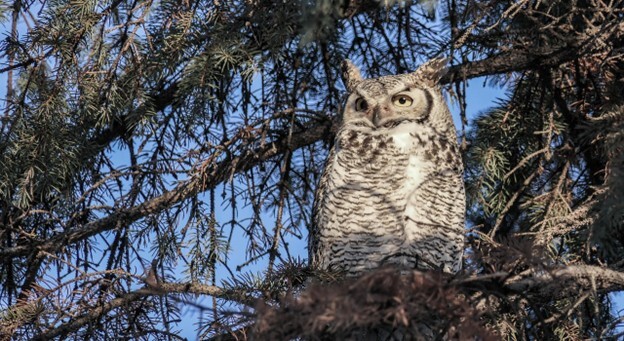 The great horned owl is one of the most powerful predators in the bird kingdom and also one of the most prolific. With facial feathers that funnel sound to their ears, exceptional night vision, and soft feathers that mask the sound of their flight, they are marvels of evolution’s engineering skills. They can be found in forests, grasslands, deserts, swamps, and suburban backyards, because their diet is varied, feeding on everything from larger birds of prey to small mammals, frogs and even other owls. Great horned owls are crows’ most threatening predators – the boogey man they warn their children about. It’s not unusual to see crows rally their forces to dive-bomb owls in the middle of the day, often driving them out of the neighborhood, temporarily.
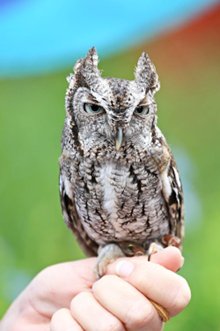 Eastern screech owls, at 6 to 9 inches long, are at the other end of the size spectrum, and they make a tasty morsel for great horned owls. We have several of the wee birds in the neighborhood too. Masters of camouflage, a screech owl can completely blend with tree bark. They like nesting boxes or hollows in trees for their daytime naps and to raise their young. Like the great horned, the female is larger than the male, but the male has a deeper voice. One of their calls sounds like a horse whinnying. They prey on a variety of songbirds, including the European starling, so considering the number of starlings we have, the buffet for them is always filled. But starlings, knowing no fear, will often take over a screech owl’s nest box, and the owl will move on. That’s what we birders call chutzpah.
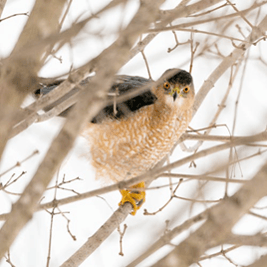 Cooper’s hawks are one of our most frequent visitors to bird feeder sites, preying as they do on songbirds primarily, but also larger birds such as chickens. If suddenly everything goes quiet in your yard and nary a bird stirs, figure that there’s probably a Cooper’s hawk in the vicinity. I’ve seen a downy woodpecker swing to the underneath of a branch barely wider than itself, and cling there motionless for ten solid minutes until the word went out that the hawk had flown away.
Cooper’s hawks are beautiful birds, with grey backs and red bars across pale breasts. They have distinctly striped tails in charcoal and gray with white tips, and the cap on the head looks like a bad toupee that doesn’t quite blend with the feathers below it. That’s one way to tell it from its smaller lookalike, the sharp-shinned hawk. Cooper’s hawks have caps (toupees), while sharp-shinned hawks have hoods.
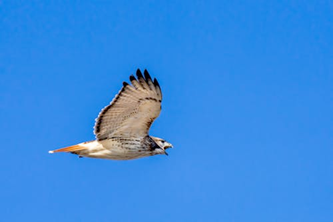 If a shadow flies across the yard and this time feeder birds choose to ignore it, it’s not because they’re oblivious to danger. It’s probably because the shadow was thrown by a red-tailed hawk. A much bigger bird than a Cooper’s, it prefers mammals over birds, though I guess nothing is off the table if it is really hungry. It’s superbly adapted to life on the wing. One the largest birds you’ll see in our skies, you would think it would weigh comparably, but the female only weighs 3 lbs. Seen from below, they are pristinely white underneath with black wingtips and a red tail. This is the time of year, if you’re lucky, when you could see a courtship display high in the sky. The male and female soar in wide circles. The male will dive steeply and then rise up at the same steep angle. Sometimes the two birds will grasp each other with their talons and plummet in spirals before they let go at the last minute and rise again. Keep your eyes on the sky in February and March.
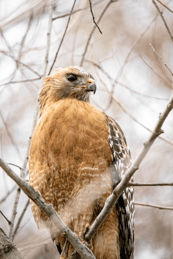 Finally, the last avian predator that calls the Bird Streets home is the red-shouldered hawk. A highly territorial hawk, who will nest in the same area year after year, the red-shouldered is one of our most strikingly patterned native hawks. It has arose-colored breast and shoulders, with beautifully barred wings and a striped tail. They eat reptiles and amphibians and occasionally small birds and are usually forest dwellers, so we’re lucky to have one (or two?) here in the neighborhood. They can be aggressive when defending their territory and have been known to attack crows. They have also been known to join up with crows to go after great horned owls, believing in the adage that the enemy of my enemy is my friend.
We love our songbirds, but there is something magnificent about an avian predator, evolved so flawlessly to hunt prey and in the process keep populations in check. And to live in a neighborhood that supports nature both big and small is truly an honor and a delight.