.png?width=1452&height=474&name=Greenspace%20Logo%20copy%20(1).png)
I mowed my yard today, and two things happened. I startled a snake, and a snake startled me. A little garter snake, a fellow explorer of the world. She with her belly connected to the earth, me with my head in the air. After we both settled down, we studied each other. I looked at her and she took in my scent with a darting tongue. I admired her beautiful markings—and told her so—and how her muscles rippled effortlessly when she moved a bit out of my way. She may have pitied my great clumsiness. (I’m assuming here.) For that moment, our bubbles of awareness, our umwelts, overlapped into a Venn diagram of recognition.
It was a little thing, but I felt peace for the moment we shared a bit of space and time. I can’t speak for the snake.
What is this umwelt besides a word I’m throwing around to impress you with my knowledge of the German language? (Full disclosure, I say four things in German – thank you, milk, good morning, and now umwelt, which has no direct, one-word translation.) Umwelt is the term for a species’ sensory environment – what it sees, hears, feels, tastes, smells. In other words, how it engages with the world.
In my little snake’s world, scent comes in stereo, not only through her nose but through her forked tongue. Her tongue-flicking creates vortices of air that direct scent molecules toward her. Each tip picks up scent molecules from a different direction, thereby leading her toward prey or away from danger. Our sense of smell is not so specific. I have been known to stand still in the middle of the sidewalk, searching for the source of a lush scent of lilac or honeysuckle. My two nostrils only detect odors in mono, so I have no idea where it’s coming from. I turn to use my eyes and direct my nose better, but tracking down the source of that scent often requires more skill than I have. Snakes, who could home in on it immediately, would pity my narrow ability. If snakes feel pity can be left for another discussion at another time.
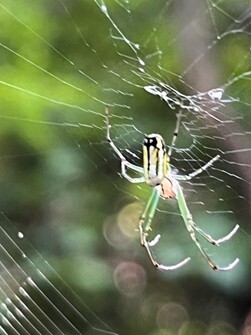 In my human clumsiness, I often “collide” with another’s umwelt. I was walking through the woods early one morning, when the path is usually a head-high minefield of spider webs. (When hiking first thing in the morning, take a friend and make them go first.) The breeze moved the leaves, and just in time, sunlight skipped across the path, catching a few strands of a web right before I would have plunged my face through it. In the center, an orchard orb weaver spider rested (photo, left, by Carol Spence). Did she know I was there? The leaves shimmied again, and this time the light struck her directly, changing her from dull and nearly invisible to gleaming white with emerald legs that matched the forest behind her web. Did she see me taking her picture or only feel me when I accidentally touched a web thread? I apparently vibrate differently than a gnat or a hoverfly because she ignored my stumbling maneuver.
Though she has evolved with eight eyes, each is a single lens. They are better than camera lenses at collecting light – helpful if you hunt at night and require light shifts to tell you when it’s time to build your web – but the retinas in many spiders’ eyes are composed of coarsely grained receptors, so their resolution isn’t as good as ours. Instead, they rely on touch, vibration, and taste to navigate or locate prey. So “my” spider probably didn’t see me as more than a shift in light patterns or an ill-defined figure. And my clumsy brush with her web didn’t feel like prey’s frantic vibration. In other words, I barely entered her personal umwelt, though she was very much a part of mine.
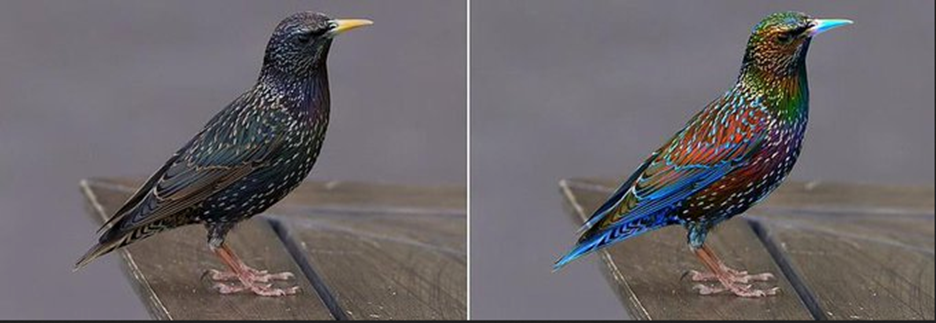
(Left) How starlings look to humans. (Right) How starlings may look to each other.
Photo by James Gurney. Gurney Journey Blog https://gurneyjourney.blogspot.com/2023/04/how-starlings-see-each-other.html
Many bird species, particularly songbirds and hawks, have a fourth cone type in their eyes that can see ultraviolet light, whereas we poor humans only have three and cannot. Birds can see things that are completely invisible to us. Their visual world is much more vibrant than ours is. When a bird looks at a European starling, for instance, they see more than we do. While we see a dull bird with flat black feathers, they see a masterpiece painted by Nature. Field studies have shown that songbirds use UV cues when selecting a mate, foraging for food, or social interactions. Using their UV receptors, hawks can track rodents by following their glowing urine trails.
On the other hand, owls have very low UV sensitivity, evolution having traded that for superior night vision.
All of Nature’s creatures have their own, specific umwelt, evolved because of particular needs or certain environmental conditions. But at some point, that Venn diagram will show an overlap, whether slight or large, between us all. Similarities are good, but the diversity in our individual perception is much more interesting. It’s a reminder that magic is all around us, even if we don’t always notice it.
By Carol Lea Spence
Kentucky Master Naturalist and Neighbor