.png?width=1452&height=474&name=Greenspace%20Logo%20copy%20(1).png)
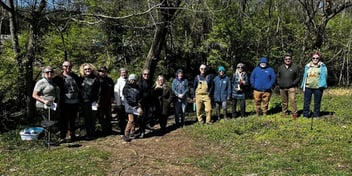
June 13, 2026, we gathered in the greenspace for a Developing Community Greenspaces Workshop
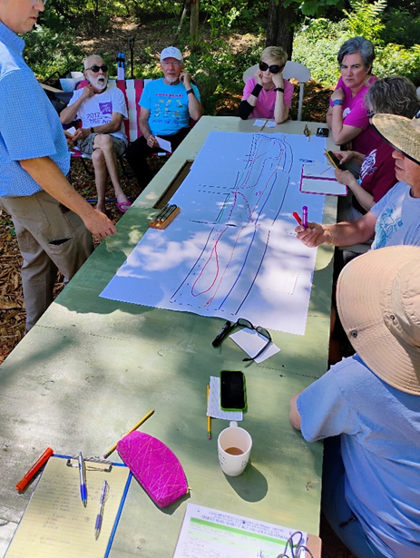 This Bob-O-Link Greenspace workshop, facilitated by Human-Nature Systems, guided seven stakeholders through a process to identify how the community engages with the greenspace. Most participants had experience with thisx and other greenspaces and were curious about how the process to develop plans for Bob-O-Link can be useful at other greenspaces as well.
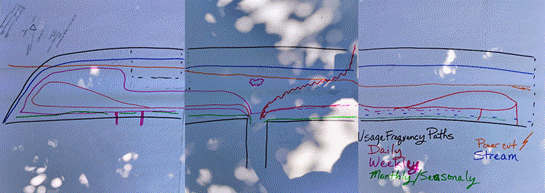
The first activity initiated a “macroscopic perspective” and prompted teams to visit separate sections of the greenspace to identify the variety of greenspace visitors, access points, and how different areas of the greenspace are utilized. A map of frequency patterns was then created to visualize observations, discuss preferences, and prioritize improvement options.
Findings clarified that the greenspace serves a diverse user base (including neighbors, students, commuters, and dog walkers) and functions as both a destination for recreation and nature engagement as well as a corridor for pedestrian and bicycle commuters (identified by central “cut-through” routes). Stakeholders emphasized improving access and safety at existing informal entry points and crossings, especially where current use patterns are already established, while maintaining flexibility in how the space supports different uses across zones.
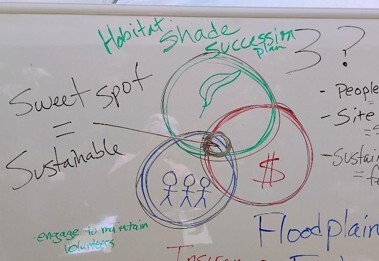 Building from this, participants were guided through a discussion of the 3 pillars of sustainability: where environmental, social, and economic conditions overlap to create a “sweet spot.” Social priorities included community use by adults, areas for children to safely explore and play, educational opportunities, alongside the need for quieter areas that support solitude and connection with nature. Environmental perspectives highlighted development of wildlife habitat, shade, and stream buffer. Economic considerations focused on feasibility, including funding (grants) and capacity/costs for maintenance. A key insight from the workshop was the recognition that while many ideas may be generated regarding what human stakeholders want for a greenspace, only a subset of those may be sustainable as a result of their alignment with what the land can support and resource capacity to sustain desirable outcomes in the long term.
Overall, the workshop identified a clear preference for improvements that support ecological health and build on existing use patterns–with an emphasis on prioritizing those interventions most likely to succeed within the constraints and opportunities of the site. There was also discussion about specific projects to work on next, and succession planning for generational transition.
.jpg?width=352&name=Greenspace%20Gathering%20Visit%20with%20Neighbors%20(1).jpg)